Palanga guide

Birutė Park and the Amber Museum in Palanga

2–3 hours on foot
All year round

Birutė Park and the Tiškevičiai Palace at its centre are the one place in Palanga worth seeing whatever the weather, the season or your age. A hundred hectares of trees, one hill, one chapel, one stone grotto and one of the most interesting museums in Lithuania, all on a single route.

‍

From the Prie Parko hotel to the palace is about ten minutes on foot. Allow two to three hours for the whole loop described below, museum included.

Address
Palanga Amber Museum, Vytauto g. 17, Palanga
Opening hours
15 May – 15 Sept: Tue–Sat 10.00–20.00, Sun 10.00–19.00. 16 Sept – 14 May: 10.00–18.00 and 10.00–17.00. Closed on Mondays.
Tickets and contact
Summer €8 / €4, off-season €6 / €3. Tel. +370 460 51 319
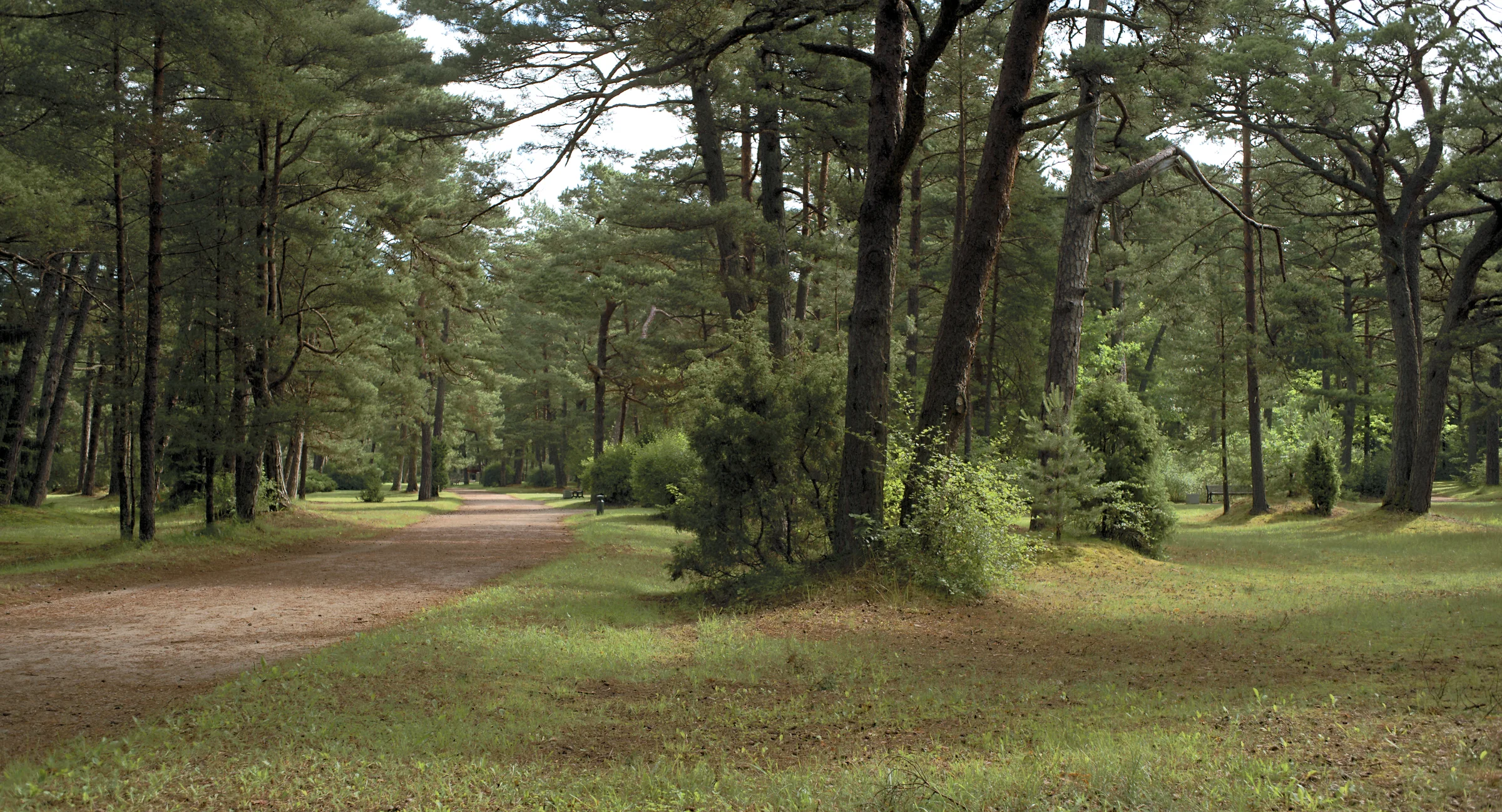
Pine avenue in Birutė Park, Palanga
The park

The park covers 101.3 hectares. Its landscape plan was drawn up at the end of the 19th century for the Tiškevičiai counts by the French landscape architect Édouard François André, together with his son René and the Belgian gardener Buyssens de Coulon; 1897 is taken as the park’s symbolic founding date.

‍

This is not just a patch of woodland by the sea. André planned vistas that still work today: from the palace parterre the eye is drawn into the distance, and the paths are laid out so that it is hard to get lost, yet you keep turning off somewhere without meaning to.

‍

The park holds up to 250 species of introduced trees and shrubs and about 370 species of naturally growing herbaceous plants, 24 of them rare in Lithuania. In summer the orangery is open, from 1 June to 31 August, daily 10.00–19.00.

‍

It was designated a state-protected botanical park in 1960, so today it is at once a 19th-century manor garden, a botanical collection and an ordinary town park that Palanga locals walk through on their way to work.

The palace and the museum

The neo-Renaissance palace was built in 1897 for Count Feliksas Tiškevičius. It was designed by the German architect Franz Heinrich Schwechten, at the time one of the best-known architects in Berlin.

‍

On the south side the palace is ringed by a semicircular rose garden, and in front of the main facade lies the parterre with its fountain, which is where most photographs of Palanga are taken. In summer the roses are in bloom; in spring and autumn the geometry of the parterre itself shows better.

‍

The palace houses the Palanga Amber Museum, a branch of the Lithuanian National Museum of Art. The permanent exhibition fills 15 rooms, from how amber forms and its inclusions to jewellery.

‍

The museum is closed on Mondays and public holidays, and closes an hour earlier on the eve of a holiday. Last entry is one hour before closing, the most important number to remember if you are planning an evening visit. Guided tours run Tuesday to Friday and must be arranged in advance.

Birutė Hill

The hill in the southern part of the park is the oldest part of the site. According to legend, this is where the priestess Birutė lived before Duke Kęstutis took her as his wife; their son was Vytautas. In 1989 archaeologists found remains of a pagan cult on the hill, so the legend has a tangible basis too.

‍

At the top stands the octagonal neo-Gothic Chapel of St George, built of red brick in 1869 to a design by the architect Karol Majer. Its stained-glass windows date from 1976.

‍

For decades the summit was trampled freely, and the archaeological layer suffered badly. Today visitors are asked to climb only by the built steps and paths, the only way to preserve what is left.

‍

From the hill a path leads straight towards the sea, so many people end the route here; from the chapel to the water is a matter of minutes.

Not to miss along the way
  • The Lourdes grotto, built of natural stone in 1899 for Countess Antanina Tiškevičienė; the mason was the French master Bonhomme. A listed cultural heritage site since 1997.
  • The sculpture Eglė, Queen of the Grass Snakes, by Robertas Antinis the elder, placed in 1960 beside the main path to the palace.
  • The rotunda, a bandstand built in 1927. In summer the Palanga orchestra still plays here for free.
  • Love Avenue, a path along the edge of the park leading towards the sea; the water is only a few dozen metres away from it.
How to walk the loop

The easiest option: enter the park from S. Darius and S. Girėnas Street and head towards the palace, passing the Lourdes grotto and Eglė, Queen of the Grass Snakes on the way. At the palace visit the museum, which deserves at least an hour, then turn south and climb Birutė Hill.

‍

From the hill walk down towards the sea and come back along Love Avenue or simply along the beach. The loop takes about an hour without the museum, two to three with it.

‍

The route works just as well in winter: the park is open all year round, and off-season the museum is both cheaper and emptier.

Worth knowing
Entry to the park itself is free; you only need a ticket for the museum in the palace. The paths are sandy and rooty in places, so with a pushchair it is easiest to keep to the main avenues. The park is a few minutes from our door, which is why guests usually walk this loop on their first morning, while the park is still quiet.
Palanga guide
Other articles
Enquiry
We’ll reply within 24 hours.
Room
Name
Email
Check-in date
Check-out date
Message
Thank you! We’ve received your enquiry and will reply as soon as we can.
Your message could not be sent. Please try again or call +370 460 51175.